
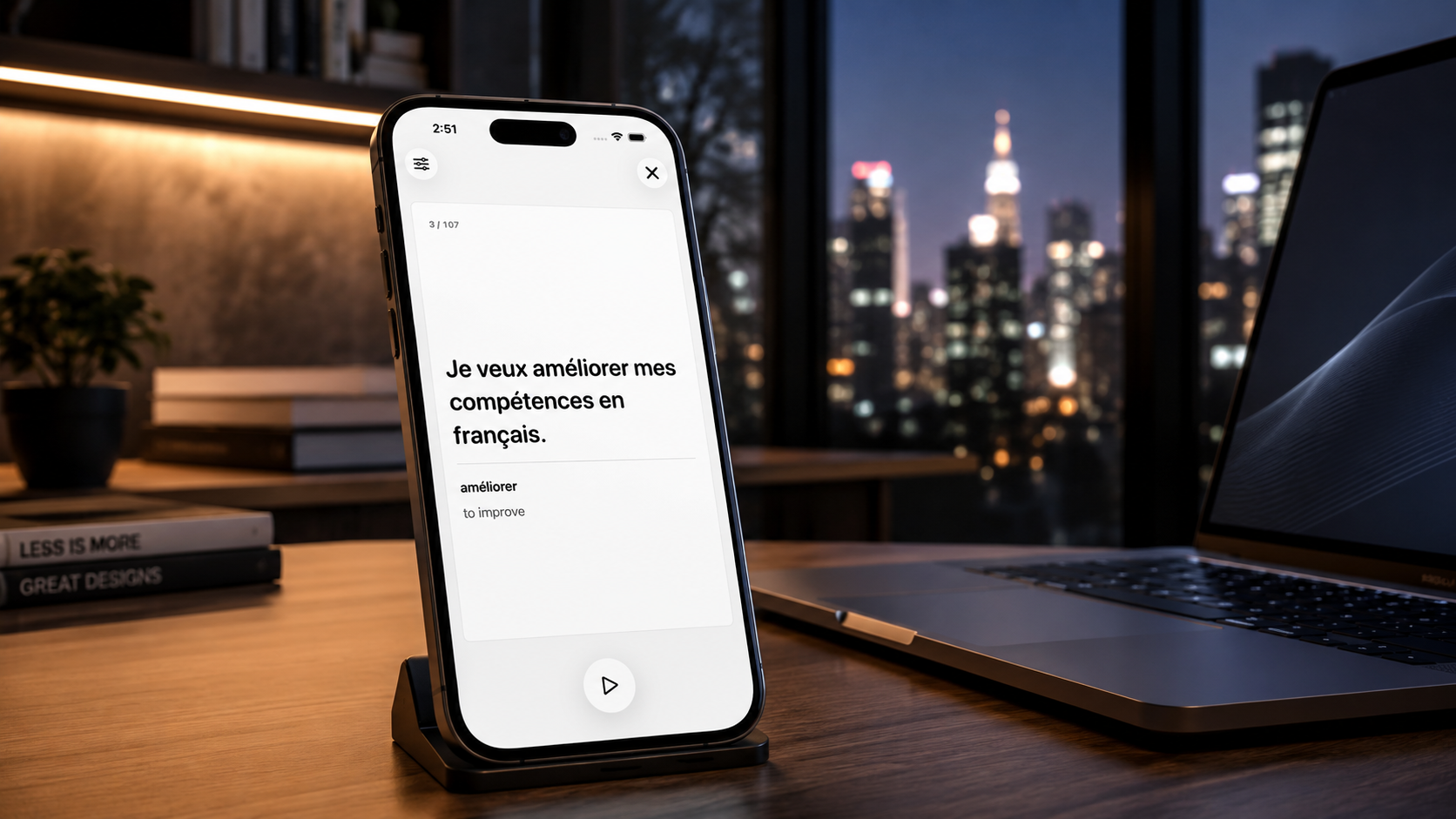
French shadowing is a speaking exercise in which you listen to a short piece of French and repeat it almost immediately, following the speaker like a shadow. Instead of reading each word slowly, you copy the sounds, rhythm, and movement of the whole phrase. It is a practical way to connect the French you understand with the French you want to say.
What is the shadowing technique?
In a shadowing exercise, you listen through headphones and speak along with a recording. Your repetition stays just behind the original voice. At first, that delay might be a full phrase. With practice, it can become only a word or two.
This is different from ordinary listen-and-repeat practice. Pausing after every sentence gives you time to remember the words and plan each sound. Shadowing asks you to keep moving. That gentle time pressure encourages you to hear French as connected speech rather than a row of separate vocabulary items.
The goal is not a perfect accent. Aim to make your French easier to understand and more comfortable to produce. Clear rhythm and connected phrases matter more than copying every tiny detail at once.
Why shadowing helps your French pronunciation
French on the page does not always tell you what French will feel like in conversation. Final consonants may disappear, words can link through liaison, and stress belongs to a group of words rather than every individual word. Shadowing makes these patterns audible and physical.
When you imitate a complete phrase, your attention moves beyond single sounds. You begin to notice where the speaker groups words, which syllables become prominent, how the voice rises or falls, and where it pauses. Repeating those features trains the timing of your speech as well as the position of your mouth.
How shadowing supports listening and speaking
Shadowing gives your listening a specific job. You are not only trying to understand the message, you are listening closely enough to reproduce it. Small details that are easy to miss become useful clues: a linked consonant, a reduced vowel, or the shape of a question.
At the same time, you build ready-to-use speaking patterns. Frequently repeated groups such as j’aimerais bien, est-ce que vous pouvez, or je ne suis pas sûr start to feel like complete units. That can reduce the effort of assembling a sentence word by word during a real conversation.
A simple French shadowing routine
Begin with a clip of 15 to 30 seconds. A short, clear passage is enough for one focused session.
- Listen for meaning. Play the full clip once without speaking. Make sure you understand the situation and the main idea before concentrating on pronunciation.
- Read and notice. Use a transcript if one is available. Mark unfamiliar words, likely liaisons, pauses, and the phrases the speaker groups together.
- Repeat one phrase at a time. Pause after each short phrase and imitate it. Copy the rhythm and melody, not only the individual consonants and vowels.
- Shadow the recording. Play the clip again and speak just behind the voice. If you lose your place, rejoin at the next phrase instead of stopping immediately.
- Say it independently. Turn off the recording and deliver the passage in your own voice. Then reuse one of its phrases in a new sentence that is true for you.
Choose material at the right level
Good shadowing material is natural but manageable. You should understand most of it after one or two listens, and the speaker should be clear enough to imitate. A dialogue, short story, app conversation, or brief podcast excerpt can all work. One speaker is usually easier than a fast group discussion.
A difficult recording may feel more advanced, but it can turn the exercise into guessing. If you cannot identify the words or keep pace after several slower attempts, choose an easier clip. Progress comes from noticing and reproducing useful patterns, not from surviving the fastest audio you can find.
Common shadowing mistakes
The first is trying to shadow too much audio. Repeating the same 20 seconds with attention is more useful than rushing through ten minutes. The second is reading the transcript while ignoring the voice. The text should support your listening, then move out of the way.
Another common mistake is focusing on speed before clarity. Slow the recording or return to pause-and-repeat when necessary. Finally, do not practice only the sounds that are comfortable. If a phrase repeatedly breaks down, isolate it, say it slowly, and rebuild its rhythm before putting it back into the full passage.
Turn imitation into conversation
Shadowing becomes especially useful when the borrowed language enters your own speech. After every session, choose one phrase and adapt it. Change the subject, the tense, or one important detail. Then answer a related question aloud without the recording. If a missing word interrupts the answer, use these French conversation recovery phrases to keep going.
For example, after shadowing Ce week-end, j’aimerais bien visiter Montréal, keep the frame and make it personal: Ce soir, j’aimerais bien regarder un film français. You preserve the pronunciation pattern while using it to express a new thought.
Five to ten minutes of French shadowing a few times a week is enough to create a useful routine. Listen closely, imitate a small section, and carry one phrase into conversation. Over time, the sounds and rhythm you once had to copy deliberately can become a more natural part of how you speak. You can make that repetition consistent by adding it to a simple daily French speaking routine.