Forgetting a word does not mean your French conversation has to stop. Native speakers forget words too: they describe the object, ask for help, or try a different sentence. Learning to do the same in French is a real speaking skill, not a workaround. The phrases below help you stay in French long enough to find the meaning together.
How do you ask “How do you say…?” in French?
The most direct phrase is Comment dit-on … en français?, meaning “How do you say … in French?” It is useful when you know the English word and your conversation partner understands English.
For example, you can ask Comment dit-on “receipt” en français? The answer is un reçu. Repeat the answer in a complete sentence Est-ce que je peux avoir le reçu? so the new word immediately becomes something you can use.
Useful phrases for asking about a word
Comment ça s’appelle? - What is that called?
Quel est le mot pour…? - What is the word for…?
Qu’est-ce que ça veut dire? - What does that mean?
Vous pouvez répéter, s’il vous plaît? - Can you repeat, please?
Keep the new word active. When someone gives you the missing word, say it back in a sentence of your own. Save the complete phrase, then use active recall for French speaking to retrieve and say it again later.
Say that you do not know the exact word
Sometimes it helps to tell the other person what is happening. Je ne connais pas le mot exact means “I don’t know the exact word.” You can also say J’ai oublié le mot (I forgot the word) when you know you have learned it before.
Add mais… and continue with whatever you do know: Je ne connais pas le mot exact, mais c’est quelque chose qu’on utilise dans la cuisine. You have not ended the conversation. You have invited the other person to help solve the small puzzle with you.
Describe the word instead
Talking around a missing word is called circumlocution. It is one of the most useful habits a language learner can build because it keeps you communicating with the vocabulary you already have. Describe what the thing does, what it looks like, where you find it, or what it resembles.
Four sentence frames that work
C’est quelque chose qu’on utilise pour… - It is something you use to…
C’est une personne qui… - It is a person who…
C’est un endroit où… - It is a place where…
C’est un peu comme…, mais… - It is a little like…, but…
Imagine you forget un parapluie, the word for umbrella. You might say: C’est quelque chose qu’on utilise quand il pleut. On le tient au-dessus de la tête. That description is clear enough for your partner to supply the word, and you have practiced far more French than a quick switch to English would allow.
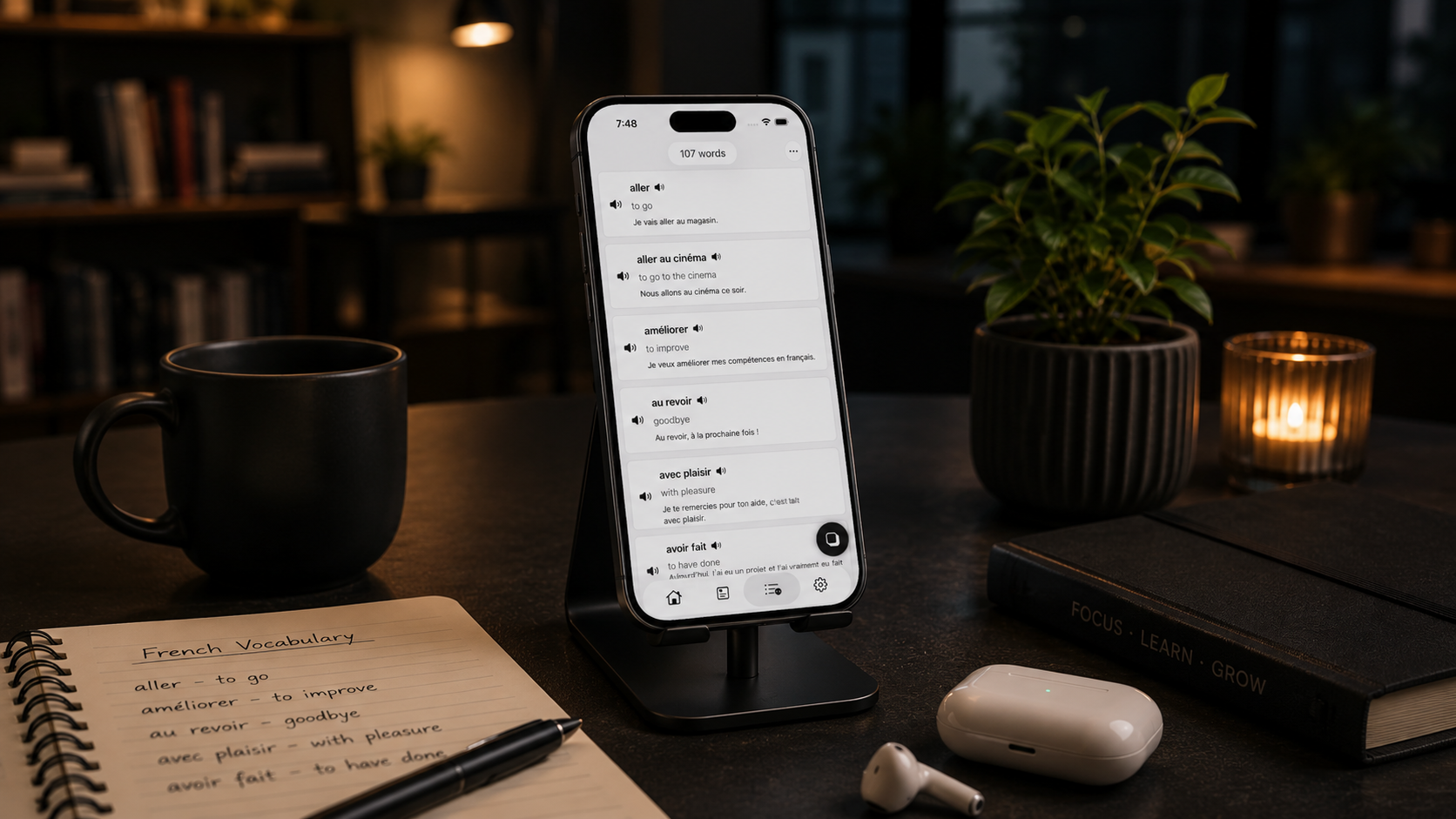
Practice getting unstuck with Parlez-Vous. Start a French conversation, describe a word you cannot remember, and save the useful answer to your phrase collection. Try out Parlez-Vous for free.
Buy a little time while you think
A short pause feels longer to the speaker than it does to the listener. French fillers give you a moment to organize your thought without surrendering your turn. Use them lightly; one calm phrase is usually enough.
Alors… - So… / Well…
Voyons… - Let’s see…
Comment dire… - How can I put it…
Attendez, je cherche le mot. - Wait, I’m looking for the word.
These phrases sound more natural when you have already said them aloud. Add one to your next daily French speaking practice session and use it before you actually need it.
Check that your meaning is clear
Once you have explained the idea, confirm that the other person followed you. Ask Vous voyez ce que je veux dire? for “Do you see what I mean?” In a casual conversation, use Tu vois ce que je veux dire?
If you think you have understood a new word, check it with Ça veut dire…? followed by your guess. You can also ask C’est bien ça? - “Is that right?” These small checks prevent a misunderstanding while keeping the exchange collaborative.
A simple way to practice recovery phrases
You do not need to wait until you get stuck in a real conversation. Practice the recovery itself:
- Choose an everyday object. Pick something nearby, but do not say its name.
- Describe it in two sentences. Explain what it does, where it belongs, or what it looks like.
- Ask for the word. Finish with Comment ça s’appelle? or Quel est le mot pour ça?
- Reuse the answer. Say a new sentence containing the word, then save the full phrase for another conversation.
Try the exercise with a speaking partner or in an app conversation. Afterwards, use focused French shadowing practice to repeat the best phrases with natural rhythm and pronunciation.
The goal is communication, not perfect recall
Strong speakers are not people who never forget a word. They know how to stay engaged when recall is imperfect. Ask a clear question, describe the missing idea, listen to the answer, and use the new word immediately. Every recovery becomes another minute spent thinking and speaking in French.
Start with three phrases: Comment dit-on… en français?, C’est quelque chose qu’on utilise pour… and Vous voyez ce que je veux dire? Once those feel automatic, a gap in your vocabulary will feel less like the end of a conversation and more like a normal part of one.