A French phrase can look completely familiar on the page and still disappear when you try to say it. That gap is not unusual. Recognizing an answer and producing it from memory are different tasks. Active recall gives you practice with the second one: bringing French to mind before a real conversation puts you on the spot.
What is active recall in language learning?
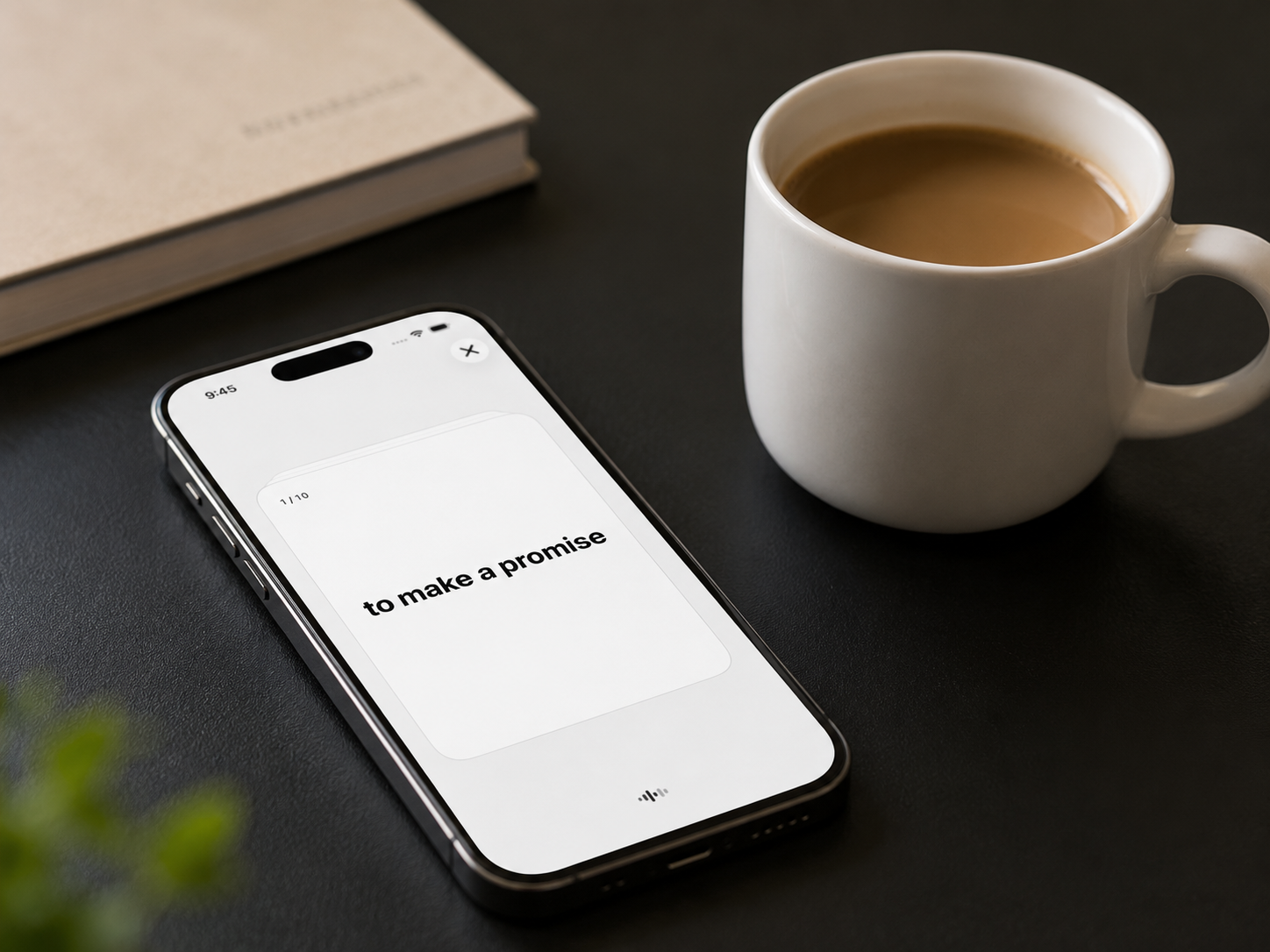
Active recall means trying to retrieve something before looking at the answer. For French speaking practice, that can be as simple as reading an English phrase such as “to make a promise,” recalling faire une promesse, and saying the French aloud. Only then do you compare your response with the phrase you saved.
This is different from rereading a vocabulary list. When both languages are visible, the French may feel obvious because the answer is already in front of you. Hiding it creates a small, useful challenge. You have to find the words, arrange them, and move your mouth before you can check your attempt.
Give yourself time to answer. A few quiet seconds of searching are part of the exercise. If you reveal the saved phrase at the first hesitation, you practise recognition instead of recall.
Why recognition is not enough for conversation
Reading and listening often give you clues. The sentence around a word, the speaker’s tone, and the word itself can all help you recognize its meaning. Speaking reverses that direction. You begin with an idea and have to produce the French without seeing or hearing it first.
That is why passive vocabulary can be much larger than active vocabulary. You may understand ça dépend instantly when someone else says it, yet reach for a slower explanation when you want to say “it depends.” Spoken recall gives that useful phrase a direct route from meaning to speech.
Why you should say the French aloud
A silent answer only checks whether you can think of the words. Saying the phrase adds the part that conversation requires: producing it clearly and at a natural pace. You may discover that a phrase you know mentally still contains an awkward sound, an uncertain article, or a pause between words that belong together.
Speaking also helps you learn phrases as complete units. Instead of constructing je vous tiendrai au courant one word at a time, repeated spoken recall can make the whole expression easier to reach for. The goal is not to rush. It is to make a useful phrase increasingly comfortable to produce.
A simple French active recall routine
Use a small collection of phrases and keep each session focused. Five careful minutes can be more useful than a long review you complete on autopilot.
- Read the phrase. Look at the English meaning once and be clear about the idea you want to express.
- Recall the French. Keep the saved version hidden while you search your memory. Try to retrieve the complete phrase, including small words and articles.
- Say your translation aloud. Speak at a comfortable conversational pace. Commit to an answer instead of leaving it as a vague thought.
- Compare both versions. Check what you said against the French phrase you saved. Notice the smallest useful difference rather than judging the whole attempt as right or wrong.
- Repeat and reuse it. Say the saved phrase clearly, then put it into one new sentence or a short answer of your own.
Choose phrases you will actually say
Recall practice works best with language connected to your life. Save the expressions that appeared in your conversations, answered a question you genuinely wanted to ask, or helped you recover when you were stuck. A personal phrase has a situation attached to it, which makes it easier to imagine using again.
Prefer complete expressions such as Je voudrais réserver une table or Je te tiendrai au courant over isolated words such as réserver or courant. Complete phrases give you grammar, word order, and pronunciation in one reusable package. You can still change a detail later when the situation changes.
If you need more useful expressions to practise, start with these French phrases for when you do not know a word. They are especially valuable because they help you keep speaking even when another part of your vocabulary fails.
What if your answer is different from the saved phrase?
A mismatch does not always mean your French is wrong. Languages often offer several ways to express the same idea. Treat the saved version as your practice target, then look at why your response differed.
You missed a small but important word
Articles, prepositions, pronouns, and verb endings are easy to blur during recall. Isolate the problem, say the complete phrase again, and keep the correction attached to the words around it. Repeating the whole expression is usually more useful than drilling one missing syllable by itself.
You used another valid translation
Compare the tone and situation. One version may be more formal, more direct, or simply the expression you originally chose to learn. If both are useful, save or practise them with enough context to know when each one fits.
You could not retrieve the phrase
Reveal it, read it once, and say it aloud without hurrying. Then hide it and try again after reviewing one or two other phrases. A blank is information: it tells you exactly which expression deserves another attempt.
Practise spoken recall with Parlez-Vous. Read a phrase, say its French translation from memory, and compare your spoken response with the version stored in your collection. Try Parlez-Vous for free.
Return to phrases across several days
Repeating a phrase five times in one sitting can make it feel easy for the moment. The more revealing test comes later, after your attention has moved elsewhere. Keep sessions short and return to the same phrases on different days. As recall becomes easier, mix older expressions with newer ones rather than reviewing only the latest additions.
You do not need a complicated schedule to begin. Review a handful today, revisit the difficult ones tomorrow, and bring them back again later in the week. A phrase that remains easy can appear less often. One that still causes hesitation can stay in regular rotation.
Turn each recalled phrase into conversation
Matching the saved version is one step, not the final goal. After a successful recall, change one part of the phrase. If you remembered Je voudrais réserver une table pour deux, try Je voudrais réserver une chambre pour trois nuits. You keep the useful frame while making the language flexible.
You can also answer a related question aloud or use the phrase in your next app conversation. This moves the expression from a card into a situation, where meaning, timing, and the other person’s response all matter. Add the routine to your daily French speaking practice so recall and free conversation support each other.
Common active recall mistakes
The first is reviewing too many phrases at once. A smaller set gives you time to speak, compare, and reuse each answer. The second is turning every difference into a failure. Focus on what changed and whether the meaning, grammar, or context needs attention.
Another mistake is practising only silently. If your goal is conversation, your voice has to be part of the routine. Finally, do not let recall replace every other kind of practice. Use French shadowing to work from sound toward speech, and use conversation to respond to ideas you could not predict. Recall fills the important space between them.
Make remembered French easier to reach
Active recall is a simple habit: read the phrase, search your memory, say the French, compare it with the saved version, and use it once more. The effort should be manageable, not punishing. Every attempt shows you which phrases are ready and which ones still need attention.
Start with five expressions from recent conversations. Practise them aloud for a few minutes, then bring one into a new sentence today. The more often your French travels from meaning to memory to speech, the more available it can feel when a real conversation asks for it.